
You don't need an AI transformation. You need one workflow fixed.
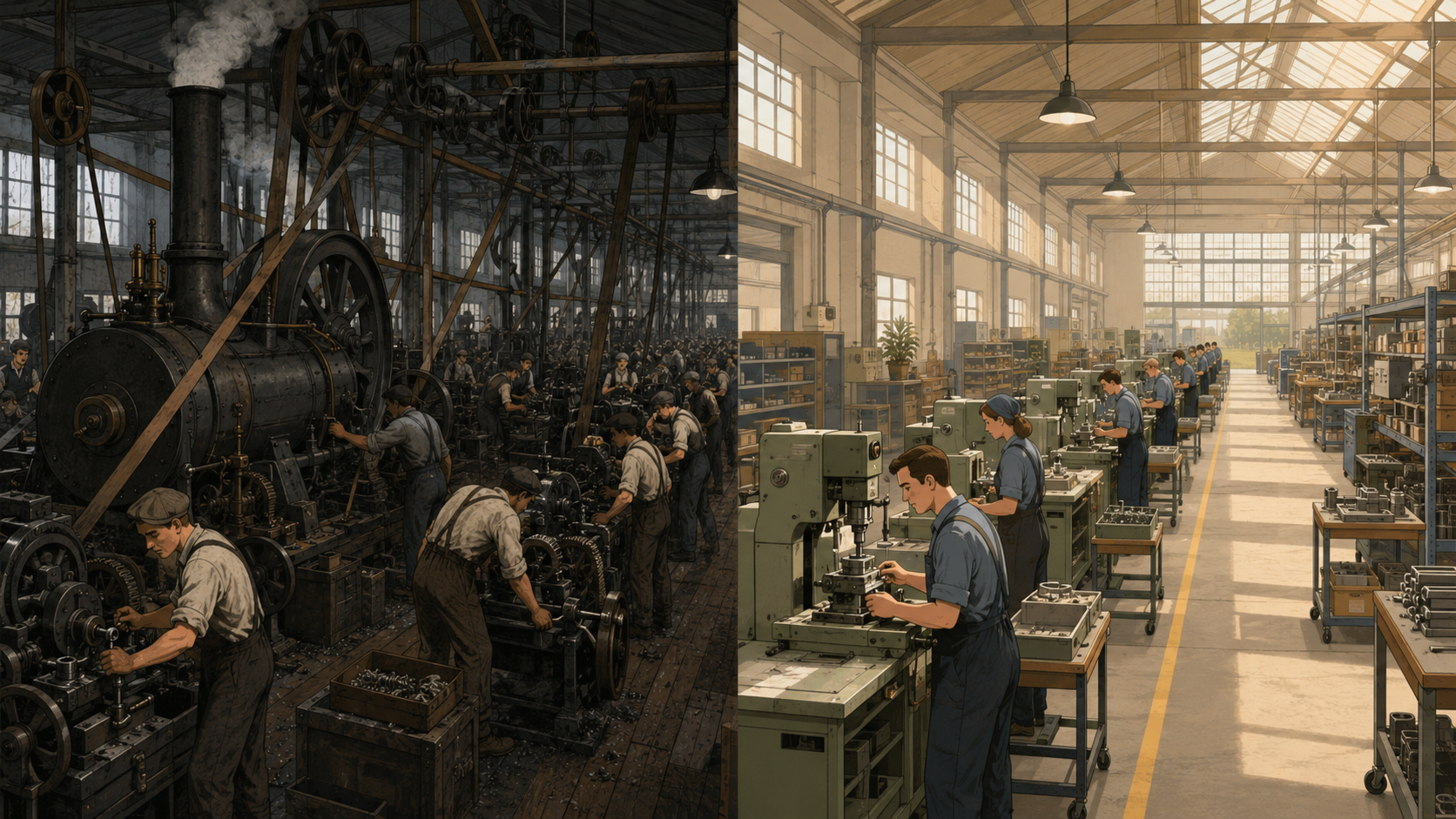
For thirty years, factories had electricity and got almost nothing out of it.
The old factories were built around a single steam engine in the basement. One engine, with belts and shafts running off it to every machine in the building. When electric motors arrived, most owners did the obvious thing. They pulled out the steam engine, dropped in a large electric motor, and kept everything else exactly the same. Same building, same layout, same belts. New technology, old shape. The numbers barely moved.
The factories that pulled ahead did something different. Electric motors could be small and cheap, so every machine could have its own. The building no longer had to be organised around one power source. Machines could sit in the order the work actually flowed. That is where the assembly line came from, and that is where the productivity finally showed up.
Henry Ford didn't win by buying electricity. He won by rebuilding the work around it.
That gap, between having the technology and redesigning around it, is the whole reason most AI spending right now produces nothing.
Buying the tool isn't the change
Every software company has now bolted "AI" onto its product. Copilot seats, AI add-ons, a chatbot widget for your website. It is easy to buy one, switch it on, and feel like you have done the modern thing.
Most of the time it changes nothing. Not because the tools are bad, some of them are genuinely good. It is that a tool dropped into an unchanged process is the steam engine swapped for a motor. The work still flows the same way. The leak is still where it always was.
An AI tool only pays you back when the workflow around it is redesigned to use it. If the AI doesn't sit at the real point where the work happens, it is a feature you are paying for, not a change you can measure.
You don't need to redesign everything
Here is the part the enterprise consultants won't tell a small business, because it doesn't sell a six-month engagement. You don't need to transform your whole company. You don't have eleven handoffs across six departments. You have a handful of processes you run every week, and usually one of them is quietly costing you more than the rest put together.
Find that one. Redesign that one. Measure it. That is the entire move.
How to spot the workflow worth fixing
The workflow worth redesigning first usually has four things going for it:
- It happens constantly. Every day, or close to it. Something you run once a quarter is not where the money is.
- It follows a pattern. Not identical every time, but repeatable. The same questions, the same steps, the same kinds of decisions.
- It's spread across tools. Information living in WhatsApp, email, a spreadsheet, a portal, a CRM, and a person spending real time stitching it together.
- You can feel the cost. Hours lost, leads gone cold, replies that took too long, invoices sent late. If you can name the number, you can improve it.
Once you have picked it, split the work into three. What a simple script can handle. What an AI agent should handle. What stays with you. The high-stakes, high-judgment calls, the real negotiation, the difficult client, the genuine exception, stay with a person. Always. Agents are for the repeatable middle, not for the decisions your reputation rides on.
What this looks like in practice
Take lead response in a real estate agency, since that is the workflow we rebuilt Conversa around.
The old shape: a lead comes in through a portal or WhatsApp, and then it sits. The agent is out showing a flat, or it is 11pm, or it is Sunday. By the time someone replies, that lead has already messaged three other agencies. The ones who answered first are the ones now talking to them. The work flowed. It just flowed too slowly to win.
The redesign is not "add a chatbot." It is handing the front of that workflow to an agent that answers every lead in WhatsApp within seconds, at any hour, asks the same qualifying questions a good agent would (budget, area, what they want, when they can view) and books the viewing straight into the calendar. The agent no longer picks up a cold conversation. They pick up a qualified buyer with a time already on the books.
The decisions that need a person still get one. Conversa qualifies and books. It does not negotiate, it does not close, and it does not pretend to be the agent. We designed that line in on purpose. An agent that knows where it stops is worth more than one that guesses.
Don't blow up what already works
One more thing, because it is where small businesses lose the most time and money.
You don't need to rip out your systems to adopt AI. You have already spent years getting yourself and your team onto whatever CRM, portal and tools you run on. A redesign that starts with "first, migrate everything" is not a redesign. It is a second job.
Build on top of what is already there. Conversa runs inside WhatsApp because that is where your leads already are. Nobody downloads an app, nobody learns a new system. The redesign is in how the work flows, not in forcing everyone onto new software. Change the process, keep the ground under it stable.
Where to start
So the honest version of an "AI transformation" for a business your size isn't a transformation at all. It is this. Find the one workflow that is leaking. Redesign how the work flows through it. Keep the human judgment where it belongs. Measure what changed. Then, once that one is solid, look at the next.
Lead response is one common leak. If you already know your leads are going cold before anyone answers them, that is the workflow to start with, and it is the one we built Conversa for.